

The Darkfield Lens: Illuminating the Hidden Micro-World

If you've ever tried to look inside a gemstone using standard lighting, you know how frustrating it can be. Surface glare blinds the eye, and the tiny internal secrets of the gem remain hidden. Enter the gemologist's secret weapon: the dark-field illuminator.
What is Dark-Field Illumination?
Standard microscopes often push light straight up through the bottom of a specimen (transmitted light). Dark-field illumination, however, employs a completely different tactic. It relies on "right angle" illumination, hitting the gemstone with strong light from the side against a pitch-black background.

Stars in a Night Sky
Why go through the trouble of changing the light's direction? The magic lies in contrast. Dark-field illumination has the incredible advantage of causing inclusions and internal imperfections to stand out brightly against a dark field. Rather than washing out the stone's interior, this lighting method makes tiny mineral crystals and fractures glow like stars in a night sky, rendering them much more prominent than they would be under normal transmitted light.

The Photographer's Nightmare
While dark-field lenses are a dream for visual inspection, they pose a unique challenge for gem photographers (photomicrographers). The primary disadvantage of this lighting method is the extreme difficulty of judging camera exposure correctly. Because the photograph consists of a few tiny, brightly lit inclusions surrounded by a vast sea of black, the great majority of the image is comparatively dark and won't even register on a standard exposure meter! Photographers often have to rely on immense skill and trial-and-error to capture these glowing internal landscapes.
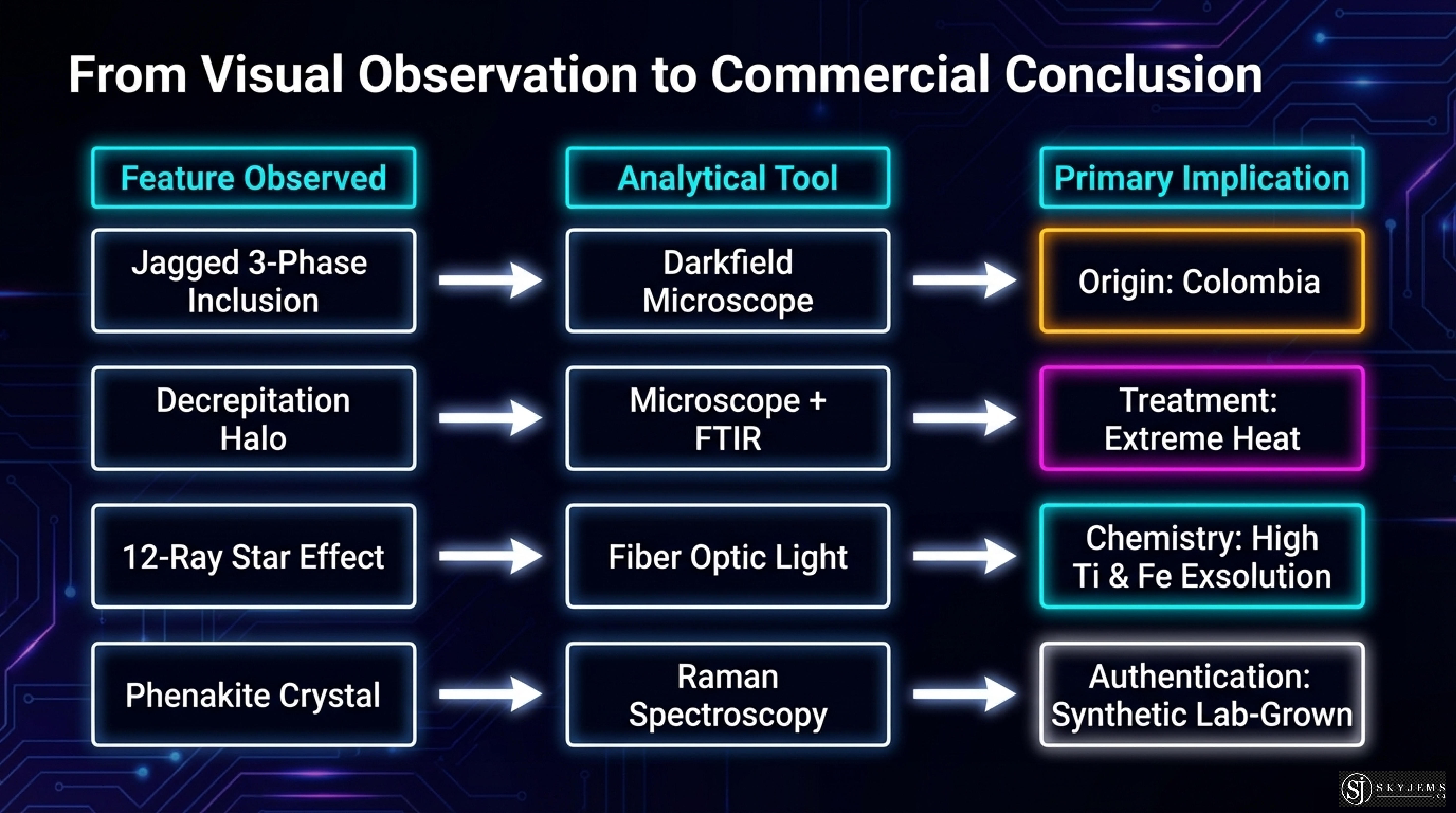
Watch the Video Series
Three short films on the technique that reveals a gemstone's hidden universe.
I · Stars in a Night Sky
II · Reading the Scars
III · From Loupe to Laser
Darkfield Trivia
Click the questions below to test your gemology knowledge!
Instead of shining light directly through the stone, the light hits the gem from the side (at a right angle) against a completely black background.
It causes inclusions and imperfections to light up and stand out clearly against the dark background, while simultaneously reducing annoying surface reflections.
Because the background is entirely dark and the inclusions are just tiny bright spots, standard light/exposure meters can't register the light accurately, making it very difficult to judge the correct exposure.


Leave a comment
This site is protected by hCaptcha and the hCaptcha Privacy Policy and Terms of Service apply.