
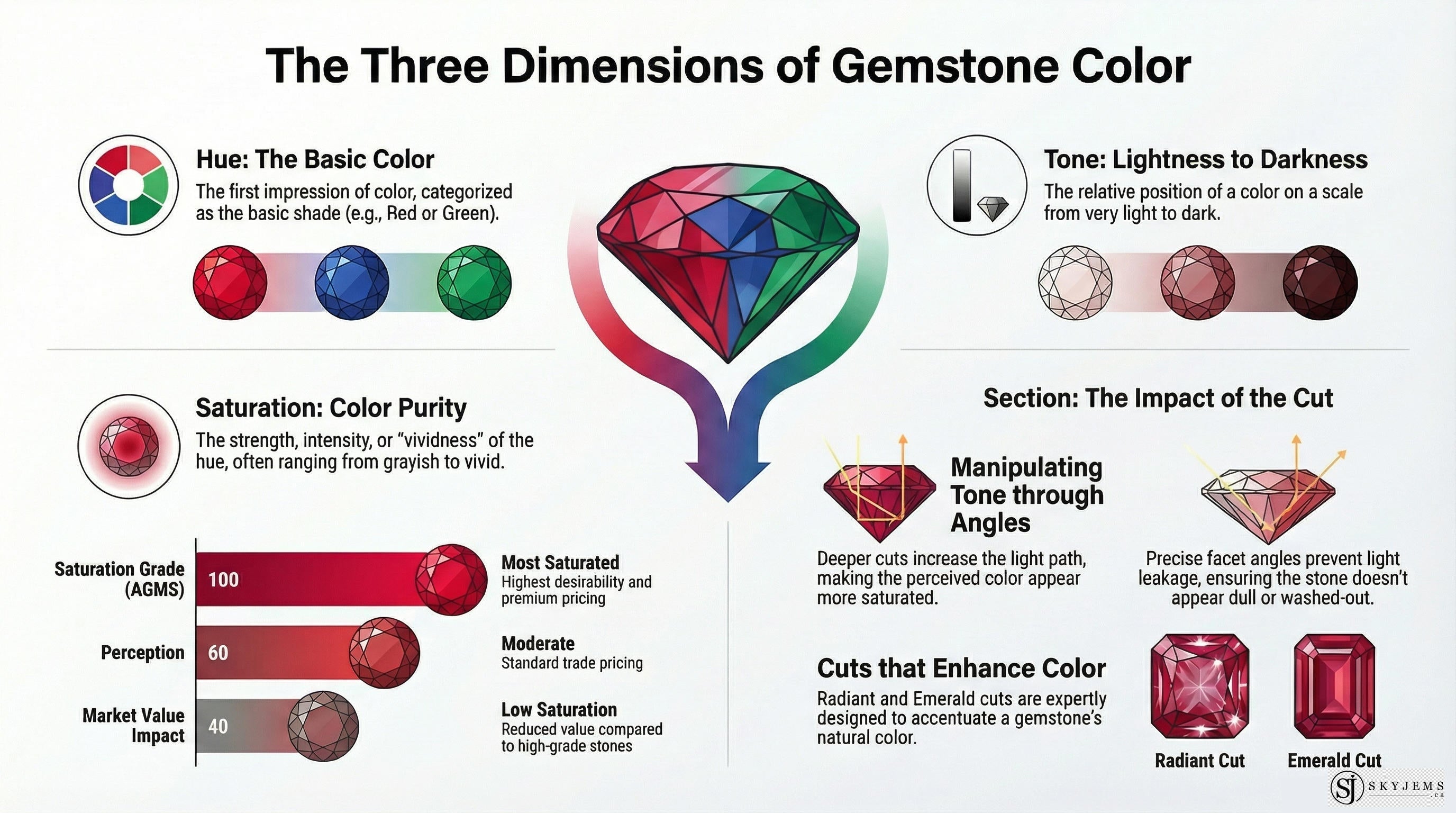
Fine, precious gemstones have been objects of desire throughout human history, and the most important quality factor driving this fascination has always been one thing: color . While the human eye can recognize millions of distinct color sensations, our attempts to describe them often seem vague and inadequate . To solve this communication barrier and accurately evaluate a gemstone's beauty and value, gemologists break down all color perceptions into three measurable dimensions: hue, tone, and saturation . Understanding this trifecta is the ultimate key to appreciating and buying colored gemstones .
1. Hue: The Core Identity
Hue refers to the basic spectral color of the gemstone, representing its dominant wavelength . When we describe a stone as red, blue, green, or violet, we are describing its hue . Because colors in nature blend together, a gemstone rarely displays just one pure primary color; it often exhibits secondary colors, creating combinations like orangy-pink, purplish-red, or greenish-blue . To standardize these descriptions globally, institutions like the GIA utilize specific hue categories to classify gems .
2. Tone: The Scale of Light and Dark
If hue is the actual color, tone dictates how light or dark that color appears . Tone refers to the relative lightness or darkness of a color, spanning a scale from completely colorless (white) through various shades of gray, all the way to black . In the GIA Colored Stone Grading System, tone is assigned a numerical value . A stone with a tone that is too light might look pale and washed out, while a stone with a tone that is too dark might extinguish light and appear nearly black, hiding the gem's true beauty . The most valuable gemstones typically possess a medium to medium-dark tone that allows their hue to shine brightly without being overly shadowy .
3. Saturation: The Intensity of Color
Saturation describes the relative strength, weakness, or purity of a color . It measures the color's intensity, progressing from a neutral or dull state to a highly saturated, vivid state . In gemological grading, a low saturation number indicates that a gem has a grayish or brownish modifier dulling its color, while a high saturation indicates a pure, vibrant, and intense "neon" pop of color . Together, tone and saturation determine the overall depth and visual impact of a gemstone's bodycolor .
The Role of the Lapidary: Cutting for Color
A gemstone's color isn't just born in the earth; it is sculpted by the gem cutter . The angles at which a gemstone's facets are cut play a crucial role in determining both its color saturation and intensity . Expertly angled facets direct more light into the body of the gemstone and reflect it back to the viewer's eye, which significantly enhances the perceived depth and richness of the color . For example, cutters know that a deeper cut allows light to travel a longer path through the gem material, effectively increasing the color saturation . However, if the cut is made too deep, the tone can become overly dark . Therefore, selecting the proper cut requires a master lapidary to constantly balance proportions to maximize color saturation without compromising the stone's brilliance .
How Professionals Grade Color
Because human color memory is highly subjective, professional gemologists do not rely on their eyes alone . In laboratory settings, experts systematically compare gemstones against standardized Munsell color chips or specific sets of master stones to assign accurate color grades . Furthermore, lighting is critical to color perception . A gemstone's appearance can change drastically depending on the type of illumination—whether viewed under warm incandescent light, daylight, or fluorescent sources—due to the uneven spectral power distribution of different bulbs .
Next time you admire a ruby's "pigeon's blood" glow or a sapphire's velvety depths, remember that you aren't just looking at "red" or "blue" . You are experiencing a perfectly balanced symphony of hue, tone, and saturation !
Watch the Video Series
Three short films decoding the three dimensions of colour, the physics of light, and the cut that makes it sing.
I · Three Dimensions of Colour
II · Ruby Under Every Light
III · Two Stones, One Crystal

Leave a comment
This site is protected by hCaptcha and the hCaptcha Privacy Policy and Terms of Service apply.