
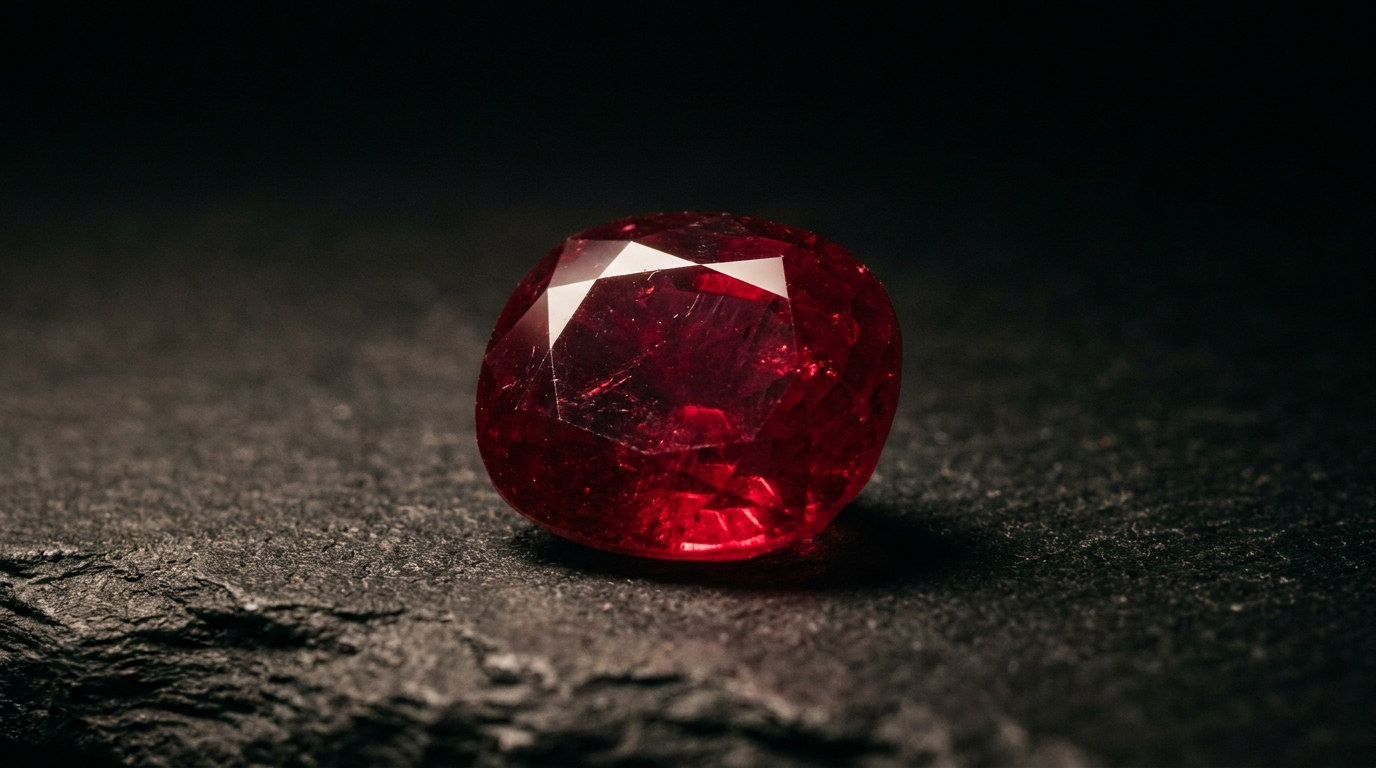
After the Ban: Why Afghan and Tajik Rubies Are the Next Mogok
Myanmar is closed. Russia is frozen. The fine-ruby supply chain has rerouted through the Himalayan foothills — and the geology says the stones coming out are chemically identical to the ones that built the legend.
In 2008, the United States sanctioned Myanmar. Mogok ruby imports — the world's pre-eminent source for over 800 years — were closed to Western buyers. The most reasonable prediction was that fine ruby prices would soften.
Instead, fine ruby prices roughly doubled over the following decade.
The supply compression from Myanmar sanctions, combined with the 2022 sanctions freeze on Russian gem exports — affecting alexandrite and demantoid most directly, but tightening the broader fine-colour supply chain — produced a structural squeeze at the top tier of the ruby market. Stones with documented pre-2008 Mogok provenance became museum-grade artefacts. New Mogok material became effectively unavailable to Western buyers through documented channels.
What emerged was an unexpected geological gift. The same plate-tectonic event that produced Mogok ruby — the collision of the Indian subcontinent with the Asian plate, fifty-five million years ago — produced a chain of chemically identical ruby-bearing marble deposits extending westward into the Pamir mountains of Tajikistan and the Jegdalek range of Afghanistan.
---
The geology is not a coincidence
The Himalayan orogeny is not a localised event. It created a continuous belt of metamorphosed platform carbonates — marble — running from Burma through Afghanistan and into Central Asia. The chemistry of ruby formation requires a very specific combination: pure calcite marble, high chromium, low iron, saline fluids circulating under extreme pressure during regional metamorphism.
Mogok, Jegdalek, and Pamir/Snezhnoe all share exactly this chemistry. The rubies that form in them have matching trace-element signatures, matching fluorescence profiles, and matching colour ranges. The defining "pigeon's blood" red of a top-tier Mogok ruby is not unique to Mogok. It is a function of the marble-hosted chemistry — and that chemistry exists in three active deposits outside Myanmar.
A gemmologist examining a fine Afghan ruby under UV and refractive index testing will measure properties indistinguishable from a fine Mogok stone. The only difference is the line in the origin-report box.
---
What the market has done with this
Between 2015 and 2025, Afghan and Tajik ruby prices at the fine-investment tier have approximately tripled. The growth rate is steep but the absolute price levels remain meaningfully below comparable Mogok material, because the origin-premium line on the lab report still carries a Myanmar bias in most Western catalogues.
This is the arbitrage.
A fine, heated, marble-hosted ruby with documented Afghan or Tajik origin trades at a significant discount to a chemically identical Mogok stone. The market has begun to correct this — the 2024 and 2025 auction records at Bonhams and Phillips have placed Afghan rubies within 20% of Mogok comparables for the first time. But the correction is incomplete. For a collector entering a ruby position today, this is the most mispriced tier in the coloured gemstone market.
The pattern is familiar to students of the coloured gemstone market. Catalogues lag geology. Collectors who understand the geology first acquire at the discount. The catalogue catches up later.
---
Documented origin matters more here than in any other species
For most coloured gemstones, origin documentation is a premium signal. For marble-hosted rubies during this transitional period, documented origin is also a provenance and ethical-sourcing signal.
Myanmar ruby has been effectively unavailable through documented, sanction-compliant channels since 2008. Rubies sold as "Burmese" in today's market with pre-2008 provenance are legitimate antiques. Rubies claimed as Burmese without pre-2008 documentation are problematic — either misrepresented origin, sanctions-evading sourcing, or both.
Afghan and Tajik rubies arrive through transparent supply chains. GIA, GRS, AGL, and Gübelin all document the origin explicitly. The sourcing is traceable. The ethical framework is clean.
For collectors building a ruby position in the 2020s, the answer is not "find a Mogok somehow." It is heated, fine, documented Afghan or Tajik — with a full origin report from a recognised laboratory.
---
What to acquire
At the entry tier ($3,000–$8,000 per carat), a fine heated Afghan ruby from Jegdalek in the 1.5–2.5 ct range with moderate to intense red saturation. Look for stones with clean GIA origin reports and standard heat-treatment disclosure.
At the mid tier ($8,000–$20,000 per carat), a heated Tajik ruby from the Pamir deposits (Snezhnoe / Trudny) in the 2–4 ct range with vivid pigeon's-blood saturation. These stones are closer to top-tier Mogok comparable in optical performance.
At the top tier ($20,000–$50,000+ per carat), a very fine heated marble-hosted ruby from either origin with documented Gübelin or GRS provenance in the 3–5 ct range. These are collector pieces that will track the ongoing Mogok-equivalent re-rating.
None of these price points are hypothetical. Every tier is represented in The Performance Basket's current archive.
---
The broader supply disruption story
Myanmar ruby is one thread in a larger pattern.
Russian alexandrite and demantoid garnet — the Uralian deposits that defined these species for 150 years — have become effectively unavailable to Western buyers since 2022. Madagascar alexandrite and new-origin demantoid have absorbed the demand, at prices that lag original Russian by significant margins.
Syrian and Iranian gem trade — the historic Silk Road flow of Central Asian stones — is fragmented by sanctions and political isolation, forcing trade through Dubai, Geneva, and Bangkok intermediaries. This adds cost but preserves access.
Zambian emerald — while not directly supply-disrupted, has captured the share of the emerald market that would have gone to Colombian Muzo / Chivor during the same period. The Kagem mine in Zambia has become the modern standard.
The pattern is the same: supply disruption at a legendary origin, re-routing to a geologically comparable new origin, initial underpricing, and a multi-year re-rating period during which disciplined collectors acquire the new-origin material at a discount to its ultimate market position.
We are in the re-rating period now.
- Build Your Hard Asset Basket Now → skyjems.ca/collections/the-performance-basket (PRIMARY)
- Prefer to read first? Download The After-the-Ban Dossier → 14-page PDF (SECONDARY — blog/PDF only)
- Acquiring over $50K? Request a Private Viewing → (TERTIARY — high-ticket only)
---
Watch the full 3:30 analysis
The 20-second version

Written by David Saad

Leave a comment
This site is protected by hCaptcha and the hCaptcha Privacy Policy and Terms of Service apply.