
She Does Not Need an Occasion
For seventy-five years, the gemstone market assumed every significant acquisition required a gift-giver and a recipient. The most consequential collector in coloured gemstones today has dispensed with that assumption entirely.
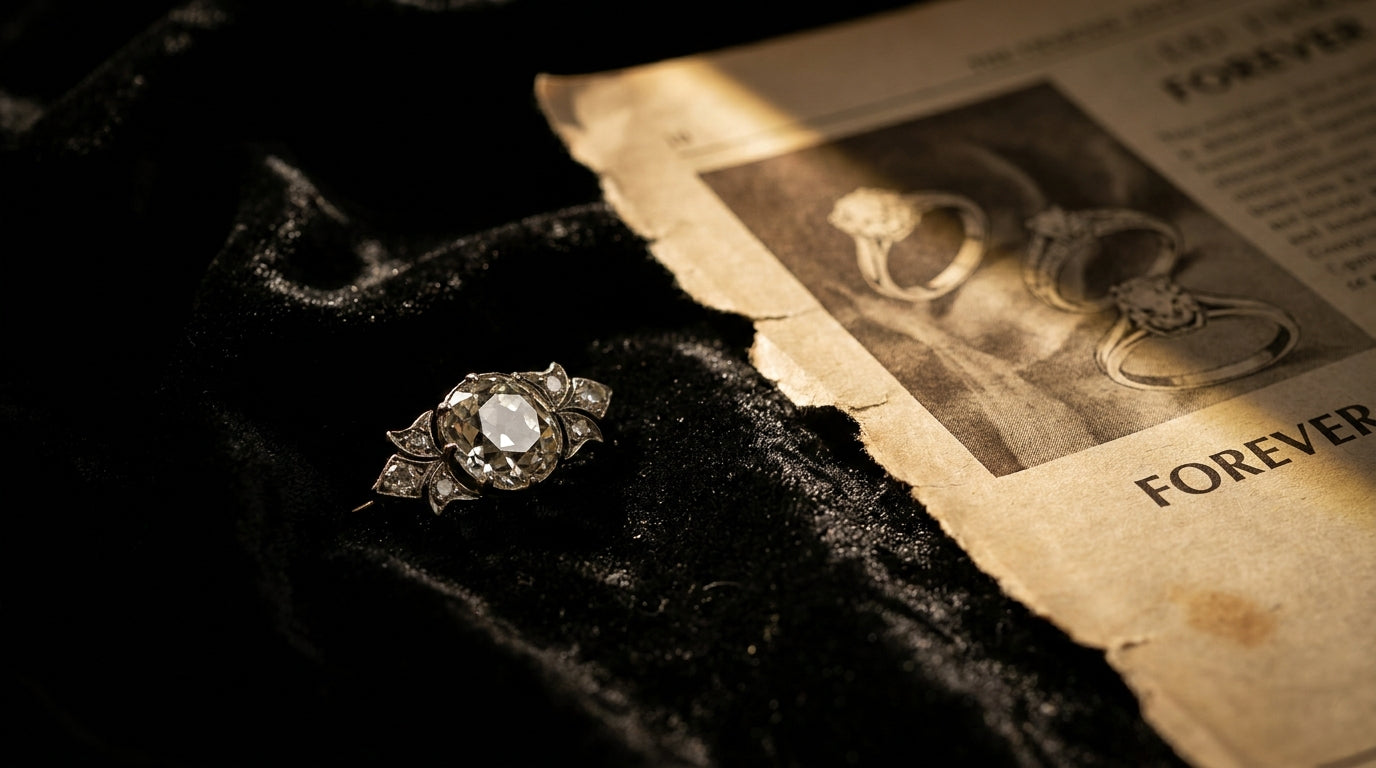
In 1947, De Beers launched "A Diamond Is Forever." It was not merely a campaign. It was demand engineering on a civilisational scale — and it worked.
The campaign installed a default: the acquisition of a significant gemstone required an occasion. An occasion required a gift-giver, typically a man, and a recipient, typically a woman. The buyer was rarely the wearer.
For seventy-five years, the coloured-gemstone market inherited this architecture. Skyjems — a family trade in fine gemstones established in Toronto in 1967 — operated within it, as every serious jewellery house did.
That architecture has collapsed.
---
The shift, observed directly
A decade ago, most acquisition inquiries at Skyjems arrived through a gifting lens. A man seeking a stone for a proposal. An anniversary. A milestone. The language was the language of occasion.
That language has changed. In recent years, a growing share of coloured-stone acquisitions have come from a buyer the marketing materials seldom described: women aged 35–65, professionally accomplished, acquiring for their own collections, without any gift narrative attached. They arrive already educated. They know what they want. They do not require an occasion to justify the decision.
The industry adapted slowly. Marketing adapted last. Coloured gemstones have always carried broader cultural registers — heirloom, personal expression, curatorial choice — because they were never fully anchored to the engagement-ring frame. The "A Diamond Is Forever" narrative was engineered for diamonds. Sapphires, rubies, spinels, and tourmalines retained a wider meaning.
The self-purchasing collector is the natural custodian of coloured gemstones. The market is only now acknowledging her as such.
---
What she acquires
The self-purchasing collector's basket is structurally different from the gift-purchase basket. Gifts favour the safe and familiar — diamond solitaires, classic rubies, standard sapphires. Self-purchases favour the specific.
Across Skyjems' self-purchasing clients, three patterns have emerged with consistency:
Paraiba tourmaline. Electric blue-green. Structurally rare. Almost unknown beyond collectors. Self-purchasers are drawn to it for its geological signal — pure, unmediated by cultural scripts. Paraiba requires no occasion. It requires recognition.
Heated Ceylon sapphire at unusual saturation. Not the conventional cornflower blue. Self-purchasers favour teal, "parti" (multicoloured), padparadscha-adjacent pinks, and yellow-greens — stones the mainstream market has not yet caught up to. Treatment is fully disclosed: heated Ceylon at heated-Ceylon price is a sound, well-documented acquisition. The collector understands precisely what she is acquiring.
Mahenge spinel and fine red spinel. Historically misidentified as ruby — the "Black Prince's Ruby" in the British Crown Jewels is, in fact, a spinel — this stone is now being recognised as a category in its own right. Self-purchasers are among the primary buyers driving that recognition.
These three stones share a single trait: none would be considered a "safe gift choice." Each is acquired by a collector who knows what she wants and requires no external validation.
---
The Performance Basket — and why it includes five species, not three
The Performance Basket reflects this reality, though it extends beyond the three stones self-purchasers most visibly favour.
Its five species — heated Ceylon sapphire, Zambian emerald, Mahenge spinel, Paraiba tourmaline, and heated Afghan/Tajik ruby — are curated for a related but distinct purpose: they represent the coloured-gemstone categories where treatment disclosure is clear, laboratory documentation is standard, and the collector can build a position with confidence across the price spectrum.
The three stones self-purchasers most consistently choose — Paraiba, heated Ceylon, Mahenge spinel — form the basket's core. Zambian emerald and Afghan/Tajik ruby complete it. They appear less frequently in self-purchaser patterns, but they anchor the basket's breadth and prevent over-concentration in any single species. A serious collection requires range.
The allocation framework — at least 20% of a portfolio in hard assets, split evenly between precious metals and coloured gemstones, acquired quarterly like an RRSP contribution rather than a lump-sum deployment — mirrors a self-purchaser's cadence. It assumes the buyer is also the wearer, the decision-maker, and the principal who will determine what becomes of the collection.
This is not a marketing pivot. It is the category describing itself honestly for the first time in three-quarters of a century.
---
The legacy question, reframed
When the buyer is also the wearer and the principal, the question of generational transfer changes entirely.
The traditional narrative was clear: a man acquires a stone, gives it to a woman, she wears it through a life, and it passes eventually to a daughter or daughter-in-law. The story was shared and understood.
The self-purchasing collector writes a different story. Her collection is her own. She may pass it on — to a daughter, son, spouse, niece, or charitable foundation — or she may choose to sell individual pieces during her lifetime and direct the proceeds as she sees fit. These choices are hers, built into the acquisition from the first day.
The provenance file, the certified laboratory reports, the properly scheduled insurance — these matter more in a self-purchase framework than in gifting, because the collector is building both the asset and the plan for its future. There is no default intergenerational narrative to fall back on. There is only the collection — carefully assembled, clearly documented, and ready for whatever she decides.
This is a more considered way to acquire significant gemstones. It may also be the more honest one.
---
- Build Your Hard Asset Basket Now → skyjems.ca/collections/the-performance-basket (PRIMARY)
- Prefer to read first? Download the Self-Purchaser Dossier → 12-page PDF (SECONDARY — blog and PDF only)
- Acquiring over $50,000? Request a Private Viewing → (TERTIARY — high-ticket only; appears here and on PDF back cover only)
---
Watch the full 3:30 analysis
The 20-second version

Written by David Saad


Leave a comment
This site is protected by hCaptcha and the hCaptcha Privacy Policy and Terms of Service apply.